Scatter
A second brain for project ideas. Capture a thought in seconds, then move it through draft, refining and ready on a kanban board or freeform canvas, with AI help shaping it along the way.
Overview
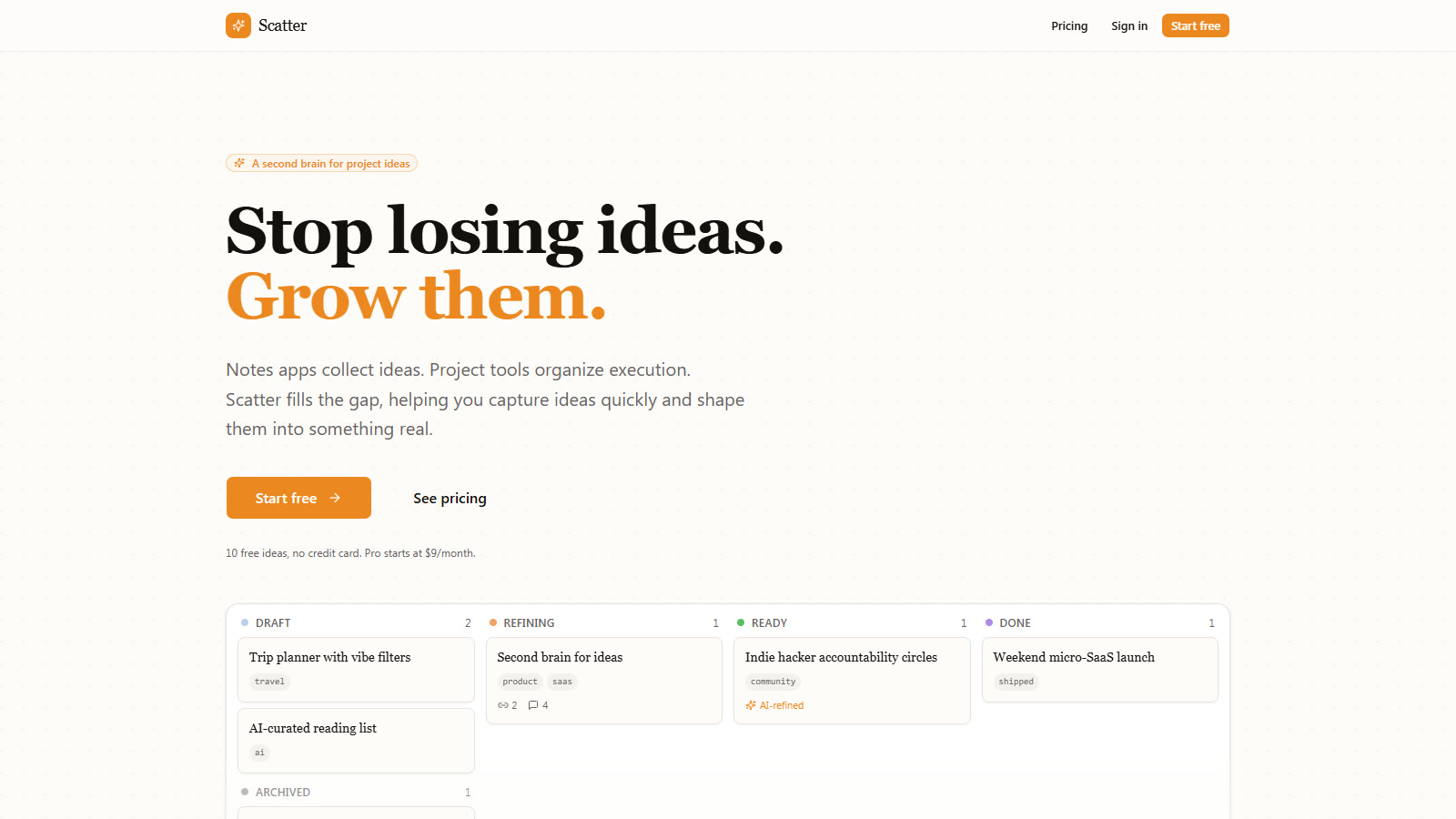
Notes apps collect ideas. Project tools organise execution. Scatter sits in the gap between them: a second brain for project ideas, where a rough thought is captured in seconds and then shaped into something real.
Ideas move through explicit stages (draft, refining, ready, done, archived) on a kanban board or a freeform canvas, with AI assistance helping to develop them rather than just store them. It runs as a hosted product with a free tier and a paid plan.
Key Features
- Capture in seconds: A global shortcut from anywhere; type or paste a URL and it's in
- Stages, not folders: Draft → Refining → Ready → Archived, so an idea's maturity is visible rather than implied
- Two views of the same ideas: A kanban board for progression, a freeform canvas for spatial thinking
- AI-assisted refinement: Ideas can be developed and reshaped with model assistance, not merely filed
- Tags, links and notes: Supporting context attached to each idea
- Real-time persistence: Changes land immediately and stay in sync across views
Technical Stack
- Frontend: React 19 with Vite, routed via TanStack Router
- Styling: Tailwind CSS v4
- Backend and data: Convex, providing the real-time reactive data layer
- Authentication: Clerk
- AI: Vercel AI SDK with Groq as the model provider
Architecture
The interesting constraint is that the same ideas are presented through two quite different interfaces, and both have to stay live.
- Reactive data layer: Convex's reactive model keeps the kanban and canvas views consistent without hand-written synchronisation between them
- Routing and state: TanStack Router handles view state, so a board and a canvas are two projections of one dataset rather than two stores
- AI through an abstraction: Model access goes through the Vercel AI SDK, keeping Groq a swappable provider rather than a hard dependency
- Auth as a boundary: Clerk handles identity, keeping account concerns out of the application logic
Challenges & Solutions
- Two views, one truth: Supporting kanban and canvas over the same ideas while keeping state consistent and real-time is the core difficulty; Convex's reactive queries make both views derive from the same source instead of drifting
- AI that develops rather than decorates: The assistance is attached to an idea's stage progression, so it contributes to moving an idea forward instead of generating detached text
- Capture friction: The value of a capture tool collapses if capture is slow, which drove the global-shortcut entry path
Impact & Results
- Closes the gap between having an idea and acting on it: Ideas get a place to evolve rather than accumulating in a notes app
- Shipped as a product: Publicly available with a free tier and a paid plan, not a prototype
- Supersedes an earlier attempt: Replaces an earlier idea-tracking project, rebuilt around stages and a reactive backend
Future Enhancements
- Expand the AI-assisted development stages
- Collaboration and sharing
- Richer canvas interactions and linking between ideas
Interested in working together?
I'm Thomas Iwainski, a Senior Software Engineer based in Sydney, Australia. Send me a note and I'll get back to you.